Introduction: The Berlin Paradox and the Third Path
After the Second World War, Germany was divided between the Western Allied powers and the Soviet Union, a temporary arrangement that quickly hardened into geopolitical reality. Berlin, though located deep inside Soviet-controlled East Germany, was itself partitioned into sectors administered by the United States, Britain, France and the USSR. In 1948 the Soviet Union sought to resolve that anomaly by cutting off all rail, road and water access to the Western sectors. The objective was straightforward: to starve the city of food, fuel and supplies in order to force the Allied powers into submission and ultimately to abandon East Germany.
The American military governor, General Lucius Clay, faced what looked like a classic strategic trap. One option was escalation: forcing supplies through by land and accepting the risk of a broader war. The other was submission: withdraw from Berlin and concede authority in the heart of East Germany. Analysts at the time treated those as the only rational options because they treated the situation as a standard game. The Berlin Airlift disrupted that logic. Rather than choosing between escalation and retreat, they changed the structure of the game itself. For nearly a year, they supplied the city entirely by air, absorbing costs that appeared irrational when judged by immediate payoff. But General Clay and US President Truman were playing a deeper game. They were running a learning experiment, one designed to teach the Soviet leadership what pressure would and would not achieve.
By maintaining the airlift despite the immense cost, the Allies were providing a consistent stream of data to Soviet Russia’s Joseph Stalin. Over time, the repetition forced Joseph Stalin and his advisers to update their prior belief about Western resolve. The contest was not over territory alone. The airlift reframed strategy as a learning process rather than a single decision. The airlift became a war fought on the terrain of probability estimation, a mechanism aimed at moving a belief variable inside the Soviet strategic model.

Adversaries as Backward Looking Learners
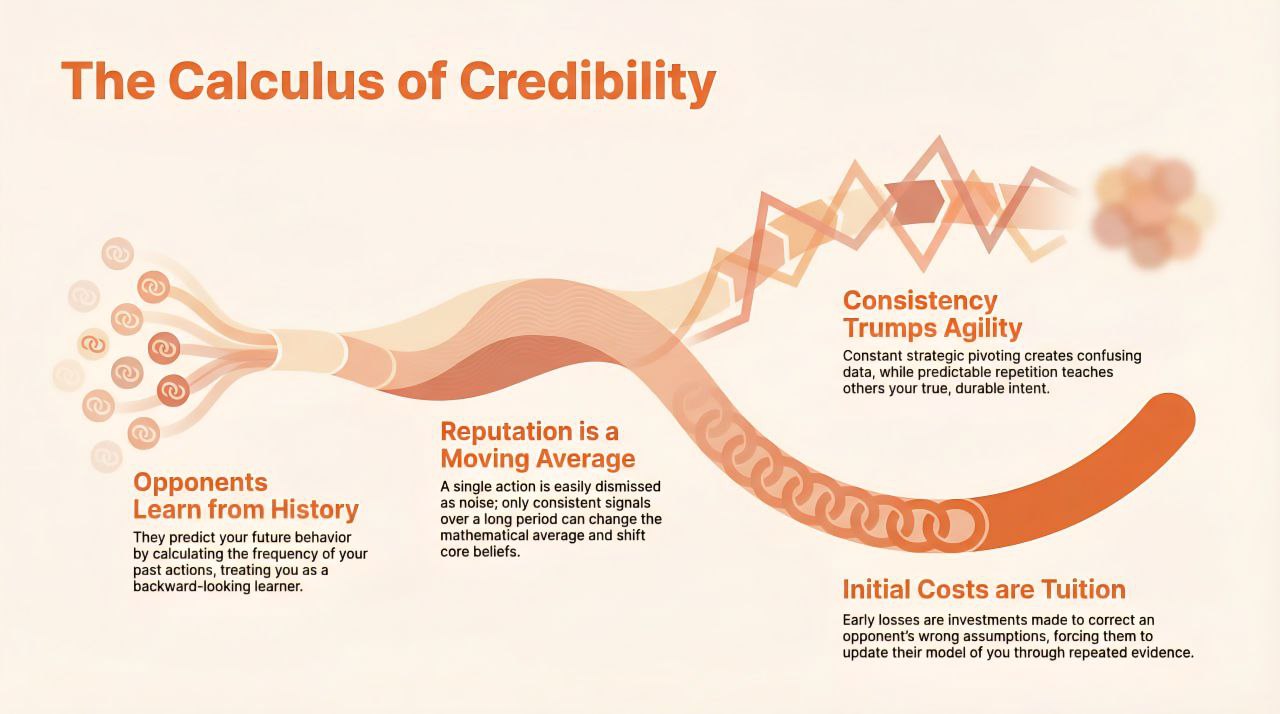
In traditional strategy, we assume standard game theory leads to a Nash equilibrium, as if actors are perfectly rational. In reality, learning models begin earlier, at the moment when beliefs are incomplete and behavior is used to infer intent. Fictitious Play makes a blunt, useful assumption: adversaries behave like backward-looking learners. They do not predict the future from first principles. They average the past. Reputation in this frame is not a declaration. It is a mathematical derivative of frequency, a moving average that shifts slowly as more evidence accumulates. If you want to change an opponent’s behavior, words are weak instruments. You have to populate their history with consistent signals until their expected distribution of your actions changes.
In Fictitious Play, an opponent’s “belief” about what you will do is not a declaration they accept. It is an empirical frequency they compute from what you have actually done. After t rounds, the belief that player j will choose action a is:
The indicator 1{⋅} is 1 when the observed action equals a, otherwise 0. In a binary setting like Berlin, where “Stay” is the relevant action, the Soviet estimate of Western resolve is just the fraction of prior rounds in which the West stayed. Each successful landing adds one more data point to that fraction. No single plane is decisive, but the frequency keeps inching upward until the prior story becomes mathematically hard to maintain. The mechanism in the notation is that the airlift worked because it turned resolve into repeated, countable evidence that could be averaged. This is how credibility gets learned.
The Mechanics of Reputation
The critical feature of the update is the denominator (t). As time passes, the influence of additional observation shrinks. This is why the Berlin Airlift had to last eleven months. A one-week airlift could be treated as an outlier, a short temporary effort that does not justify revising the model. Months of near-continuous flights reclassify the behavior as signal rather than noise. They change the mean. A first impression can steer belief toward an inefficient equilibrium, and later corrections have to fight both the opponent’s narrative and the arithmetic of accumulated history. The airlift had to persist because it was not trying to win a round. It was trying to force convergence in the Soviet belief line through repetition.
This logic generalizes cleanly to business and public policy, and it explains a common failure mode in modern business. Many organizations celebrate “agility” as if constant pivoting is the same thing as adaptive intelligence. In learning terms, rapid strategic reversals keep the market’s dataset inconsistent, so beliefs never stabilize. When a CEO changes strategy every six months, competitors and customers struggle to treat any move as evidence of durable intent. The result is not credibility but volatility. Firms then misread the volatility they created as “market uncertainty,” when it is often a self-inflicted informational problem. The strategic goal is not to win each interaction. It is to drive the market’s belief toward a specific conclusion, such as “do not compete with us on price” or “do not assume we will retreat when pressured.” That kind of convergence requires an incentive architecture of patience, one that rewards signal consistency and endurance over novelty and treats coherent repetition as a strategic asset rather than a lack of imagination. This is the same reason repeated-game logic like tit-for-tat works when it works. Its power is not theatrical toughness. Its power is predictable reciprocity that produces consistent data.

Conclusion: Stability Through Feedback and Incentives
Fictitious Play reframes early losses. When you enter a negotiation, a market or a rivalry, the opponent’s prior is usually wrong in some direction. If they begin from the belief that you are risk-averse, you should expect resistance when you behave otherwise. Those initial costs are often tuition fees, paid to fund the other side’s updating process. This is why the strategist is better modeled as a teacher than a chess player. Teaching requires a willingness to be misunderstood in the short term, because the effective way beliefs move is through repeated prediction errors that accumulate into a new expectation.
In that sense, equilibrium is not imposed. It is discovered. Stability appears when the prediction error term becomes small because the opponent’s model has adapted to your true behavior. The mistake is to treat equilibrium as intention, as if outcomes converge because someone solved the game. Systems converge because incentives, feedback and belief updating push behavior into a stable pattern over time. That is the continuity with the earlier argument for game theory. The update here is that the “game” is often a learning process before it becomes an equilibrium concept. Strategy is not control. The aim is not to force the outcome you want, but to make the other side’s best response predictable by shaping what their history allows them to believe.