Introduction: The One Percent Briefing
In November 2001, the dust from the terror attack on the World Trade Center had not yet settled. The twin towers had fallen weeks earlier and the US national security apparatus was operating under intense pressure. In a secure briefing room, US Vice President Dick Cheney sat and listened while the CIA described a novel threat. Pakistani nuclear scientists may have met with Osama bin Laden. The claim had the structure of a story more than the structure of a dataset. It carried catastrophic implications while offering very little that could be measured.
This is where ordinary governance breaks. In peacetime, decision makers mostly live inside a world that assumes clear returns, trade-offs, efficiency and political feasibility. After September 11, the category of threat changed. Decision makers were no longer optimizing within familiar space. They were staring at an event where the damage, if real, would be catastrophic. When ruin is on the table, the function shifts. The relevant frame becomes minimizing regret, where regret means the erasure of the decision maker and the system that must continue after them. Cheney interrupted the analysis and articulated what later became known as the One Percent Doctrine. If there was even a one percent chance that terrorists were acquiring a weapon of mass destruction, the United States should act as if it were a certainty. Stripped of its later politics, the move was intelligible.
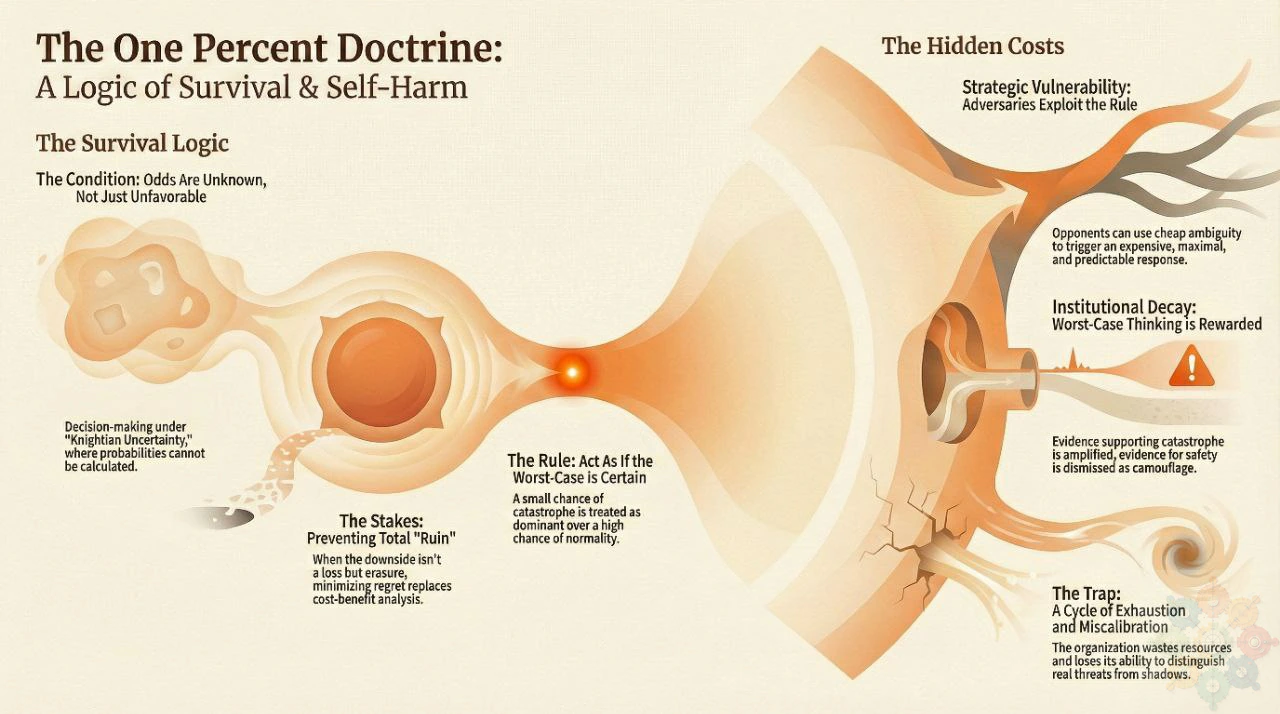
Maxmin is a survival logic. It is built to prevent ruin in a single step. That makes it rational in one sense and expensive in another. When the downside is not a loss but erasure, cost-benefit language starts to mislead. In ruin environments, efficiency metrics evaporate. The relevant question is whether you survive.

Knightian Uncertainty in Practice
Standard cost benefit analysis fails here because it presumes a stable probability term. Under ordinary risk, probabilities are treated as known. You average outcomes under a single model, then debate whether the model is misspecified. In 2001, policymakers could not assign odds to the proposition at the center of the briefing. They could not say whether the chance was 50 percent, 10 percent, 1 percent or lower without pretending to know what you did not know. That is the defining feature of ambiguity, also called Knightian Uncertainty. The problem is not that the odds are unattractive. The problem is that the odds are absent.
This is Knightian Uncertainty in its operational form. You are handed a box and asked to decide whether to open it, transport it, destroy it or ignore it. The box might contain a bomb or it might contain a kitten. The problem is not that you dislike the odds. The problem is that you do not have odds. Cheney was not necessarily suspending logic. Standard risk calculations applied to an ambiguous nuclear threat tend to produce paralysis. You can be “rational” in the wrong math and end up doing nothing while telling yourself you were prudent. From this perspective, Cheney was reaching for a decision rule designed for environments where the probabilities themselves are contested.
Maxmin as a Decision Rule
Maxmin Expected Utility is the formal rule for ambiguity when survival dominates. It treats uncertainty as adversarial. If the odds are not known, you act as if nature may choose the worst plausible probability model within a set of models you cannot rule out. The point is not pessimism as temperament. The point is robustness as structure. You choose the action that performs best under the worst plausible story. The governing rule is:
Where Pi is the set of plausible priors, ranging from “hoax” to “nuclear detonation,” the min operator forces attention onto the worst probability model in that set and is the payoff structure that treats ruin like a payoff that cannot be compensated.
This is the quiet logic behind the One Percent Doctrine. If one admissible prior assigns even a small probability to a Manhattan-scale catastrophe, the decision rule compels you to evaluate actions through that lens. The 99 percent of “safe” priors do not get equal voting power, because the cost of being wrong under the tail is not a normal loss. It is the end of the game. Under that payoff structure, a one percent chance of ruin can dominate a ninety-nine percent chance of normality, which makes “treat it as certain” a crude but legible heuristic.
The hazard is embedded in the same mechanism. The moment you make worst-case evaluation the governing principle, you also make updating harder. The comfort is coherence. However, you buy certainty by refusing to let the probability term soften the tail.
How Maxmin Becomes Playable
Once maxmin becomes public doctrine, it becomes playable. In game theory terms, a maxmin opponent is predictable. If your adversary believes you will treat small probabilities as certainties, they can exploit your decision rule without matching your capabilities. The attacker does not need to build the weapon. They only need to create the ambiguity of the weapon. The key tactic is signal injection. The adversary generates cheap noise that forces the defender to purchase expensive certainty. A rumor, a planted document or a staged contact can be enough to force the defender into costly action. The defender then pays for certainty with invasions, surveillance systems and wars.
This is economic exhaustion by arbitrage. Noise is cheap to manufacture. The One Percent posture converts ambiguity into a standing demand for maximal response, which lets an adversary buy your overreaction at a discount. Over time, this also degrades credibility. If you respond at maximum intensity to too many shadows, you lose the ability to concentrate attention when the predator is real. Credibility is not declared. It is accumulated. Maxmin reduces one category of risk while creating a new one. You reduce the probability of ruin from the feared tail while increasing the probability of self-inflicted strategic exhaustion. Survival logic can become a machine for wasting strength.

Conclusion: The Institutional Addiction
When an organization adopts a maxmin framework, it changes what gets rewarded. Under risk, analysts are supposed to be rewarded for accuracy over time. Under maxmin, the analyst who imagines the most catastrophic admissible scenario becomes institutionally valuable. The result is a Bayesian failure. Evidence that supports catastrophe gets amplified. Evidence that supports safety gets discounted, then reinterpreted as camouflage. Absence of evidence becomes evidence of stealth. The institution begins to feel analytical while drifting into systematic miscalibration.
Law makes the incentive asymmetry easier to see. Courts impose burdens and standards of proof because treating every allegation as ruin would destroy the system’s legitimacy. In national security, the One Percent posture functions like a permanent lowering of the threshold, where the burden shifts toward action and away from verification. It makes false positives reputationally safe and false negatives career-ending. Once that asymmetry is embedded, it becomes rational for individuals to behave as if they believe the worst-case even when they privately doubt it.
Maxmin is also psychologically addictive. It turns ambiguity into artificial certainty, which relieves anxiety while quietly distorting perception. Institutions trained to govern by worst-case priors struggle to return to ordinary risk assessment. They stop distinguishing between a shadow and a predator, then they build careers around the confusion. The corrective action is not to “ignore tails.” It is incentive design. Institutions should reward signal consistency rather than narrative confidence and track error costs on both sides. Certainty is not discipline. It is relief.