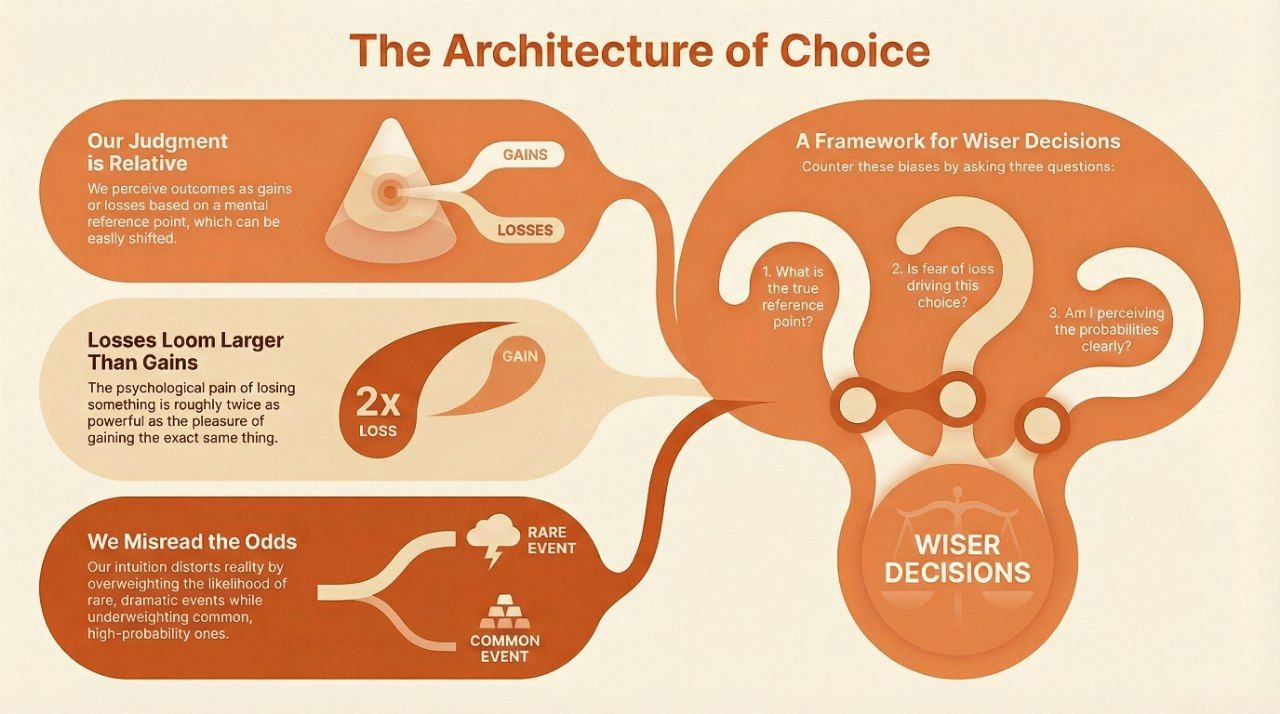
Introduction: The Limits of Rational Models
In 1978, the leaders of three countries met at Camp David, the US president’s country retreat in Maryland, for a negotiation that seemed doomed to fail. President Carter of the United States was mediating between Prime Minister Menachem Begin of Israel and President Anwar Sadat of Egypt. At the heart of the impasse was the Sinai Peninsula, a territory Israel had captured in 1967.
For Egypt, reclaiming the Sinai was a matter of national honor, a reversal of a devastating loss. For Israel, giving it up felt like a catastrophic strategic setback, sacrificing a hard-won security buffer. For days, the talks stalled. Both sides were behaving rationally from their own perspective, yet progress was not being made. The breakthrough came not from new information but from a new frame. Carter reframed the choice: instead of focusing on the loss of land, he emphasized the gain of peace, security and a normal relationship between two powerful neighbors. By shifting the psychological frame, he made the impossible possible.
This story reveals a fundamental truth for any leader: the most consequential choices are not born in spreadsheets or presentations but in the human mind, a place with its own hidden rules, biases and irrational fears.
As Daniel Kahneman and Amos Tversky showed, leaders rarely behave like ideal agents. Real decision makers distort probabilities, overreact to losses and interpret risk through emotion rather than logic. To excel in complex decision making, one must understand the psychological terrain mapped by Prospect Theory. Prospect Theory moves beyond the limits of rational models to explain why even capable leaders misjudge uncertainty and shows that mastery lies not in becoming an emotionless calculator but in recognizing predictable mental patterns and adjusting decisions to account for them.

The First Discovery: It Is All Relative
The breakthrough at Camp David revealed a simple but profound psychological insight: humans do not think in absolute certainties; we think in gains and losses. At the core of Prospect Theory lies the concept of the reference point, the mental anchor through which we judge the options we are presented with. Closely linked to it is framing, the way those options are described and perceived. Together, they explain how our perception of gains and losses shapes every choice we make. We see an outcome as not just good or bad; we see it as better or worse than what we expected. If you can shift the reference point, you can influence the decision.
This is the essence of the framing effect, the cognitive bias that alters behavior through language. In public policy, framing determines legitimacy. A government communicating an economic reform may describe it as “protecting future stability” or as “cutting current expenditure.” Both statements refer to the same measure yet the first evokes prudence while the second signals austerity, and the public’s reaction changes accordingly.
The lesson is that strategy involves not only what to decide but how to define the choice. Leaders can use framing ethically to clarify priorities or manipulatively to obscure trade-offs. Understanding the psychology of framing allows decision makers to present information transparently while guiding attention to what truly matters. The art of strategy often lies not in altering the facts but in shaping the frame through which they are understood.
Loss Aversion and the Shape of Human Value
Loss aversion sits at the heart of Prospect Theory and reveals one of the most fundamental truths about human behavior: the pain of losing something is roughly twice as strong as the pleasure of gaining the same amount. The human value curve captures this imbalance. It rises gently for gains but drops sharply for losses, showing how emotion disrupts the even logic that rational models assume.
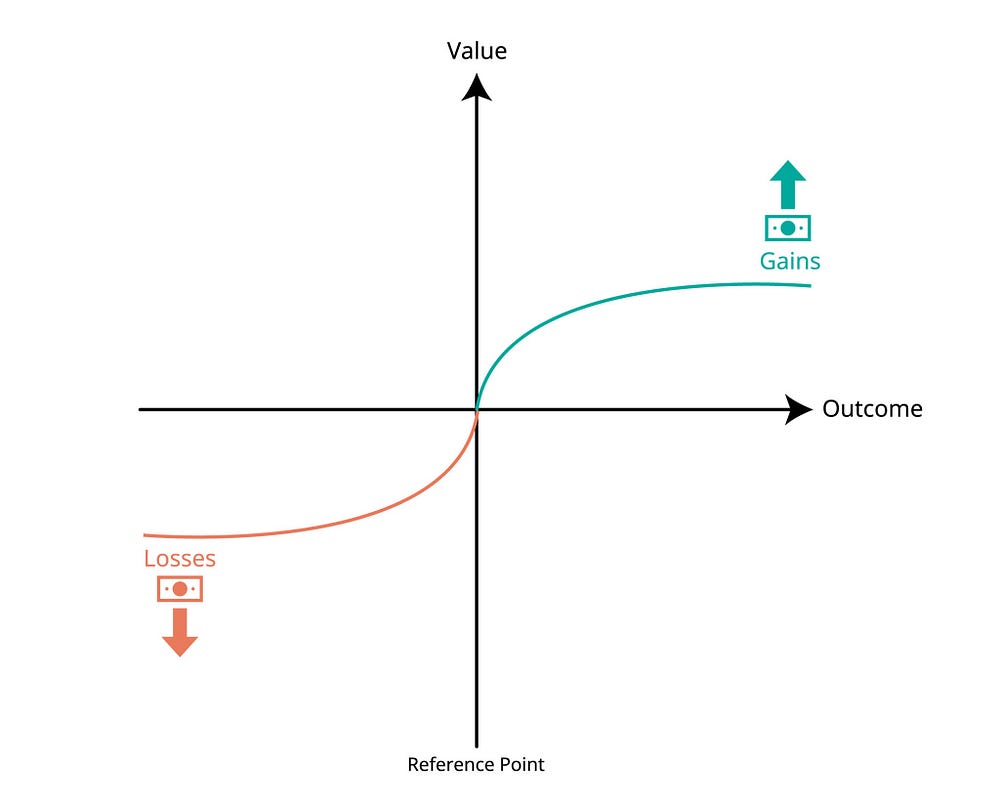
This relationship can be described as:
Here, α ≈ 0.88 reflects diminishing sensitivity, and λ ≈ 2.25 represents the strength of loss aversion. The curve’s left side, the domain of losses, is far steeper than the right, meaning a small loss feels far worse than a comparable gain feels good.
This emotional imbalance is hardwired into our brains and it distorts our decisions in profound ways. It explains why risk often feels intolerable even when the numbers suggest otherwise. In corporate strategy this effect is pervasive. For instance, a business may reject a project that could yield a $10 million gain if there is even a modest chance of losing $5 million. The arithmetic favors the investment, but the perceived utility does not. The pain of the potential loss dominates the calculation.
This instinct for self-protection often leads to excessive caution, especially in volatile environments where progress depends on taking measured risks. A disciplined decision maker confronts this bias by asking what level of loss is truly critical. By distinguishing existential losses from temporary fluctuations, leaders can separate survival from discomfort.
Loss aversion is not a defect to erase but a pattern to understand. Recognizing it allows strategy to stay bold while remaining within the bounds of sound judgment.
Probability Weighting: How Leaders Misread Risk
Human judgment does not treat probabilities as they are. We tend to overweight small probabilities and underweight large ones. Rare but dramatic events feel more likely than they are, while common outcomes seem less certain than they should. This psychological distortion shapes how both policymakers and business executives perceive risk.
In government decision making, it often appears when leaders overestimate the likelihood of rare crises such as terrorist attacks or currency collapses, yet underprepare for the slow-moving, high-probability disruptions like infrastructure decay or administrative delays. In business, the same bias can lead teams to overreact to unlikely shocks while neglecting the steady risks that quietly erode performance.
Prospect Theory captures this pattern through what it calls the probability weighting function:
where 0 < γ < 1 produces the familiar inverted S shape. Small probabilities are overweighted; large ones underweighted.
In business forecasting, this tendency can mislead even experienced executives. A firm might estimate a 90 percent chance of success for a new product, yet leadership treats it as though it were only 70 percent and hedges excessively. Conversely, a 5 percent chance of a supply disruption may be treated as a near certainty, distorting investment priorities.
The result is misallocation of attention and capital. The strategist applies structure to perception: treat small probabilities with respect but not fear, and treat high probabilities with diligence rather than complacency.
Prospect Theory in Leadership Practice
The value of Prospect Theory lies in its practical corrections. By internalizing the psychological tendencies it describes, decision makers can design systems that counter their own distortions.
- Structured framing: express both gains and losses explicitly. Avoid single perspective narratives.
- Pre-mortem analysis: imagine that a decision has failed and identify why. This counters overconfidence and hindsight bias.
- Decision audits: periodically review major choices to check whether outcomes align with initial reasoning, recalibrating future judgment.
Across business, government and judicial institutions, these practices convert self-awareness into structural discipline.

Conclusion: Mastering the Psychology of Strategic Choice
Prospect Theory’s greatest insight is not that humans are irrational but that our decisions follow predictable psychological patterns. Rational models simplify the world so it can be analyzed. Psychology restores its complexity so it can be understood. The mental shortcuts and emotional responses we rely on are not flaws but features of our cognitive wiring.
A strategist does not aim to strip away these instincts but to learn to recognize the patterns in themselves and others. To think beyond rationality is not to abandon logic but to refine it. By studying how perception shapes judgment, decision makers can correct the blind spots that formal models overlook. The disciplined decision maker learns to see both the numbers and the mind interpreting them, balancing reason with humility in every strategic choice.
Mastering this discipline requires a pause before commitment. When facing a high-stakes decision, a leader can use this knowledge by asking three guiding questions:
- What is the true reference point? Are we judging this outcome against where we are today or against an idealized future or a painful past? Can we reframe the choice to see it more objectively?
- Is the fear of loss driving this decision? Are we being too cautious in the face of a potential gain, or taking a reckless gamble to avoid the sting of a sure loss?
- Am I misreading the probabilities? Are we drawn to a long-shot possibility of a huge win while overlooking a likely but less dramatic outcome? Or are we frozen by a rare yet vivid risk?
By running this quick mental diagnostic, you bring unconscious biases into awareness. You do not eliminate the psychological pull, but you can account for it, adjust for it and decide with greater intention. That is how leaders move beyond the limits of rationality and begin to master the true psychology of strategic choice.