Introduction: The Universal Problem of Choice
Picture a CEO evaluating whether to enter a market that holds both potential and risk. The financial models show potential gains that could transform the company’s future yet political turbulence and regulatory uncertainty make every forecast fragile. The question is not simply what will happen but how much risk is worth taking. Decision theory begins at this point of tension, offering a structured way to reason through uncertainty using a compass rather than a map. The compass cannot reveal every contour of the terrain but it keeps orientation when the path ahead is unclear.
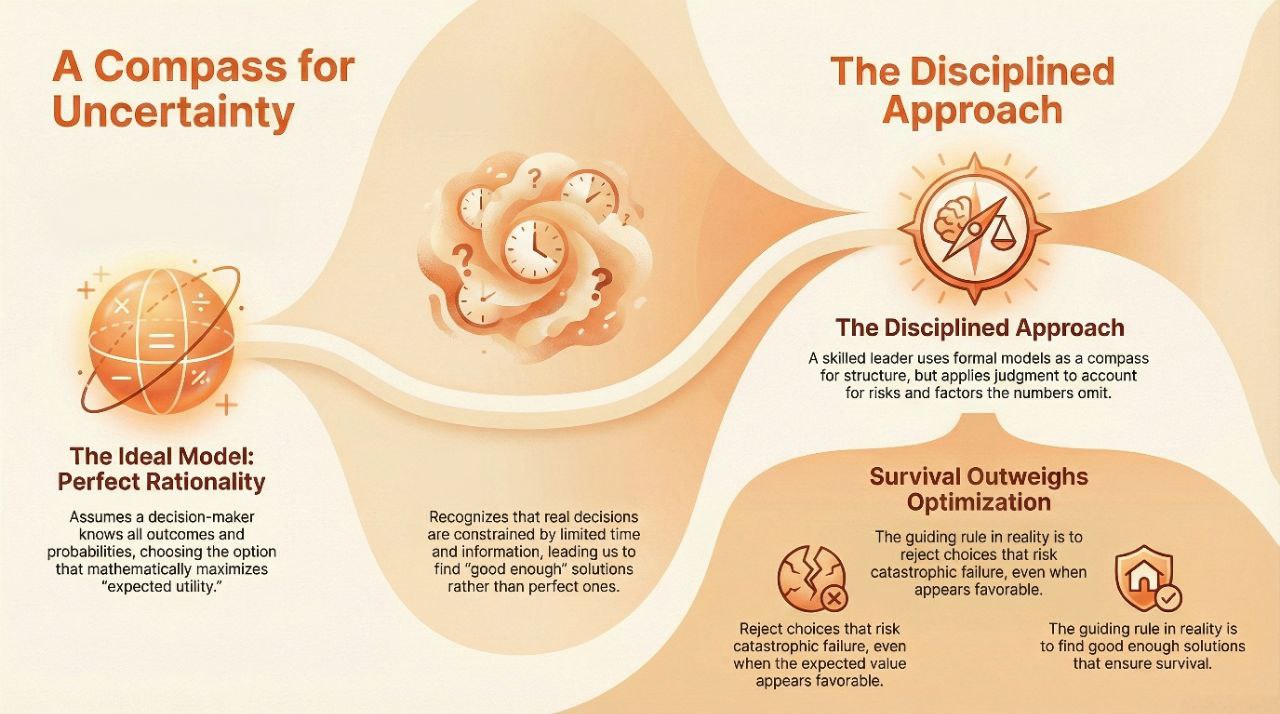
In its ideal form, perfect rationality assumes a decision maker who knows all outcomes and probabilities and can compute the best choice by maximizing what economists call expected utility, the weighted average of how desirable each outcome would feel. If an outcome x has a probability p(x), the rational choice is the option that produces the highest value of
where U(x) is the subjective value or utility attached to that outcome.
However, leaders do not live inside such equations in reality. They face pressure, incomplete information and political trade-offs. As Herbert Simon taught, they make decisions under bounded rationality, constrained by limited time and limited capacity to process complexity. They do not maximize; they satisfice, finding an option that is good enough. Often, good enough is just good enough to preserve a business or a government’s legitimacy.

Models and Reality: Perfect and Bounded Rationality
Just as a compass keeps orientation through uncertain terrain, bounded rationality helps leaders navigate complexity within the limits of perception and time. Every model simplifies reality. Decision theory outlines a world of trade-offs and probabilities, yet real decision makers face personalities, constraints and imperfect information. They cannot calculate every outcome, so they rely on heuristics, mental shortcuts that make action possible when full analysis would stall progress. These shortcuts can be useful but also risky. Overconfidence, aversion to ambiguity or impulsive risk taking can distort judgment when structure is needed most.
The gap between the ideal model and lived reality defines the boundary of rationality. As mentioned earlier, economic theory imagines an agent who always selects the option with the highest expected utility, but decision makers act within uncertainty that numbers cannot fully express. The disciplined decision maker recognizes both the power and the limits of formal reasoning.
“Human beings strive to make rational decisions but their rationality is bounded by the limits of their knowledge and their computational capacity.” Herbert A. Simon
Consider again the CEO. Analysis may show that Market B has a higher Expected Value (EV):
while Market A appears safer at
If the decision maker were purely rational, Market B would be the logical choice. Yet once emotional, institutional and reputational consequences are weighed, the calculation shifts. Using a simple utility function such as
the large gain from Market B feels smaller after accounting for risk aversion. The safer Market A may yield a lower expected return but a higher sense of stability.
The disciplined decision maker does not discard the model but interrogates it. The essential question becomes: What does this calculation omit? Factors such as strategic fit, reputation or resilience under worst-case conditions may not appear in the spreadsheet but they belong in the decision. Models clarify structure. Judgment gives them meaning.
Utility and Risk: Survival and Power in an Unequal World
In theory, decision makers aim to maximize expected value, but in reality they survive by managing risk. This difference often determines whether an organization, a state or an institution endures.
Consider two countries negotiating a trade agreement: a small developing economy and a major power. Both face the same proposal that offers long-term gains but also exposes them to short-term instability. The expected benefit may be positive for each, yet their utility functions may diverge sharply.
For the smaller state, a 10% chance of economic downturn carries catastrophic utility. It threatens jobs and political stability. For the larger power, that same level of volatility is a tolerable fluctuation within a wider portfolio of global interests. The loss in utility is modest.
The guiding rule that follows is simple:
Avoid any outcome whose worst-case utility approaches collapse.
Survival outweighs optimization. Leaders of vulnerable systems must reject choices that risk destruction even when the expected value appears favorable. Stronger states and large corporations, by contrast, can absorb volatility. Their strength lies in strategic patience, the ability to pursue high expected value opportunities knowing that over time the averages favor them. They can trade short-term discomfort for long-term advantage.
Decision theory reframes this difference as structure, not sentiment. Risk tolerance defines strategic posture. A disciplined decision maker aligns ambition with capacity, recognizing that what may devastate the fragile will only test the strong.
Coalition Deals and Judicial Choices under Uncertainty
The same principles that govern markets and strategy also shape diplomacy and judicial reasoning. In international economics, states negotiating a trade agreement face uncertainty about compliance, enforcement and shifting political interests. Each side weighs the expected utility of cooperation against the risks of dependence or exploitation. Bounded rationality appears here as satisficing diplomacy, where negotiators settle for an outcome that is adequate rather than optimal because the cost of delay outweighs the marginal gain of a perfect deal.
Judicial reasoning offers a parallel form of bounded rationality. Judges balance multiple forms of utility, such as consistency with precedent, moral reasoning and public confidence, within the constraints of law and uncertainty. The aim is not to achieve flawless coherence but to sustain legitimacy. A rigidly rational approach would treat every case as a puzzle with a single correct solution, yet justice requires sensitivity to context. Judges must decide when fidelity to precedent strengthens the institution and when flexibility better serves fairness.
Bounded rationality is not a weakness but the condition that makes reasoning possible. The disciplined decision maker structures uncertainty instead of denying it, turning complexity into a field where judgment can operate.

Conclusion: Thinking Like a Disciplined Decision Maker
Decision theory serves as both an analytical and moral compass, guiding leaders to weigh outcomes with clarity and humility. Its purpose is not to predict the future but to discipline how we think about it.
The equations for expected value and expected utility remind us that every decision carries consequences that extend beyond numbers, influencing psychological, political and institutional dimensions.
To think like a disciplined decision maker is to balance precision with restraint. Models serve as instruments of clarity, not substitutes for judgment. Whether one is choosing markets, treaties or judicial sentences, the goal is coherence rather than perfection, a consistent method for confronting uncertainty.
Those who cultivate this mindset lead with deliberation rather than reaction. They understand that uncertainty cannot be eliminated, only navigated. Decision theory, in this sense, is a compass; it cannot reveal the entire terrain but it ensures that when visibility fails, direction remains.
Decision theory does not remove uncertainty. It teaches us to face it with structure.