Introduction: The Moment a Belief Structure Faltered
On August 21, 2013, residents in Syria faced a reality that international law had deemed impossible. Rockets launched by forces loyal to Syrian President Bashar al-Assad delivered sarin gas into the suburbs of Damascus, suffocating hundreds. This was not merely a war crime. It was a direct test of American resolve.
One year earlier, US President Barack Obama had stood at a podium and explicitly defined this exact scenario as a “red line” that would alter his calculus. The world waited for the consequence that follows such a definition. The carriers moved into position. The targets were locked. But the order never came. To outside observers, the American position simply looked inconsistent. To strategic analysts, this was a massive informational shock. A boundary was breached with little consequence and the belief system of every regional actor quietly shifted.
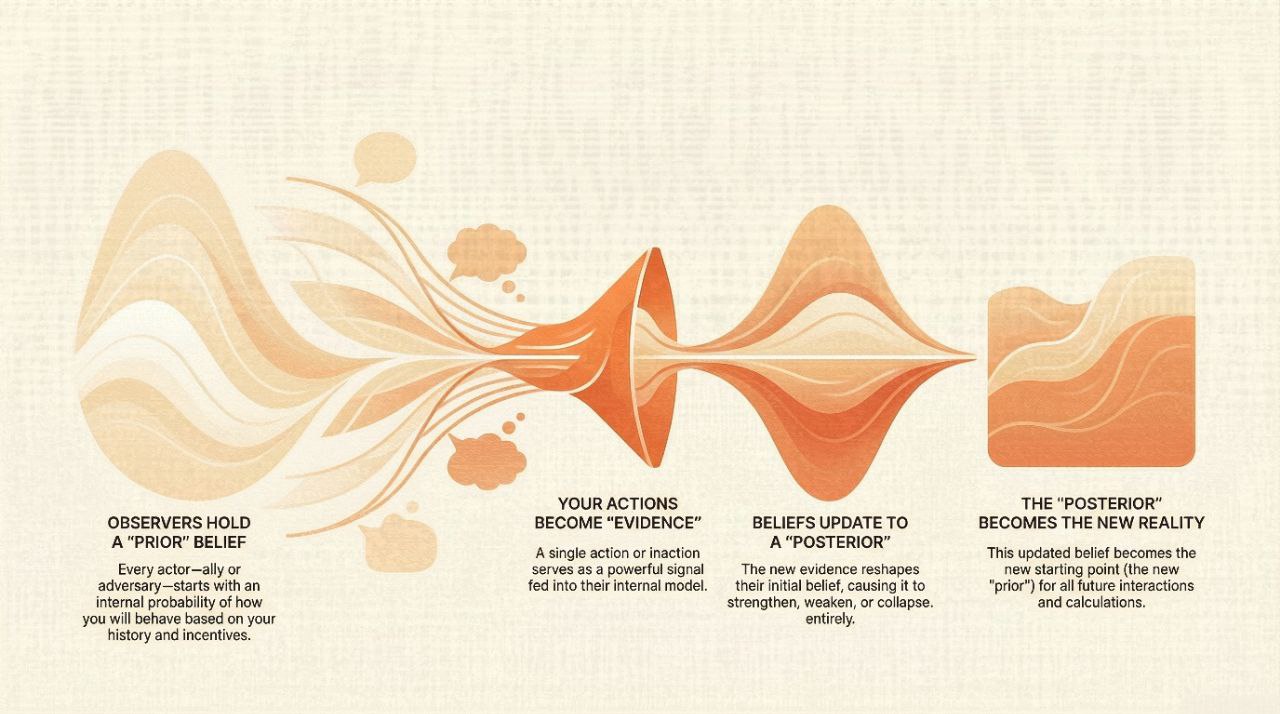
This story reveals a fundamental truth about power. Credibility is not a performative claim leaders make aloud. It is an unseen statistical variable held in the minds of observers. Opponents, allies and bureaucratic institutions all carry internal probability distributions regarding how a state will behave. Strategic environments function as learning machines. Every observed action or inaction becomes evidence that updates those internal models. There is no pause button. Leaders operate inside a cognitive ecosystem where every signal shifts the posterior belief landscape.

Priors as Foundations of Expectation
Analysts and adversaries do not enter a crisis as blank slates. They possess priors, cognitive anchors that shape how they interpret new information. These are not guesses. They are stored assumptions about propensity and resolve built from history, incentives and patterns of behavior.
To understand how these assumptions shift, we must ground our analysis in Bayes’ Rule.
where
In the context of the Syrian crisis, the variables represent a specific strategic interrogation:
- Hypothesis H: The actor will enforce the stated Red Line
- Evidence E: The Red Line is crossed and enforcement does not occur
The adversary begins with a prior belief in enforcement P(H). However, the power of the update depends on the Likelihood Ratio, which compares how likely the evidence is under the two competing hypotheses.
This ratio shows how a single diagnostic signal can dominate an entire belief system. If the threat is genuine H, the probability of observing inaction E moves toward zero. When (P(E \mid H)) collapses, the updated odds implode. One moment alters the posterior for years. The system learns that the threat was a bluff and belief in future enforcement evaporates.
Iraq as an Error in Evidential Weighting
The intelligence failure regarding Iraq’s weapons program in 2003 reflects the mirror image of the Syrian crisis. One was a failure of deterrence. The other was a failure of intelligence. In both, the structure of Bayesian judgment remains the same.
A disciplined reading of the 2003 failure shows that analysts overweighted the prior P(H) which was the belief that Iraq must have an active weapons program. They also underweighted the mundane question embedded in
How likely is similar ambiguous evidence if no such program exists?
When the prior dominates and the evidence is ambiguous, the posterior barely moves. This can be written as:
The evidence provided no directional pull. Analysts kept orbiting the same belief because they misallocated weight across the likelihoods. The Iraq case and the Syria case are structural twins. One inflated credibility and the other annihilated it. Both resulted from a miscalibrated Bayesian architecture.
Strategic Reality After the Posterior Shift
Once a belief update occurs, it actively shapes the next round of strategic interaction. A collapsed posterior has three specific consequences:
- Rivals discount future threats because the probability resolves strongly toward non-enforcement.
- Allies hedge, adjust alignments and minimize reliance on commitments that seem probabilistically unstable.
- Institutions reprice risk because credibility functions like a discount factor in bureaucratic planning.
This is not static. Belief shifts compound over time according to a dynamic updating equation:
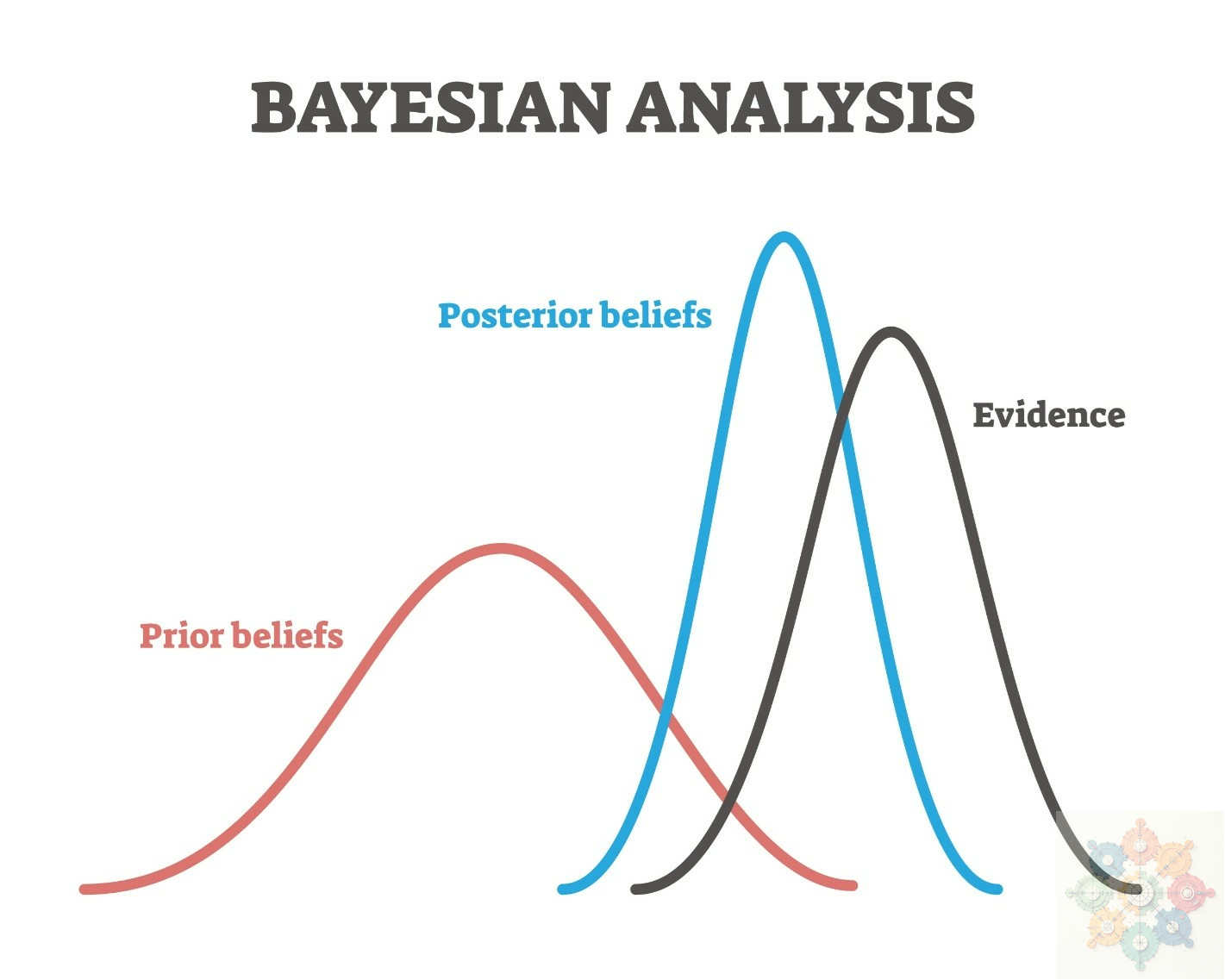
This formula explains Reputational Drift. Once the posterior shifts sharply, subsequent evidence is interpreted through the new belief state. Systems settle into a different equilibrium where restoring credibility requires unusually strong counter signals. This is not psychological stubbornness. It is statistical inertia. Each round of updating becomes anchored in the previous one.

Conclusion: Designing Decisions in a System of Inference
To navigate this landscape, we must replace reactive choices with a three-part decision framework grounded in Bayesian thinking.
1. Managing Priors
Avoid defining rigid conditional promises that create brittle priors in the minds of observers. Overly precise commitments produce posterior shocks when they fail. A leader must safeguard the priors they establish.
2. Shaping Likelihoods
Ensure that actions align with the conditional structure you signal. Maintain a high when enforcement is part of the commitment. A credible threat requires a likelihood architecture where behavior under the genuine threat hypothesis is easily distinguishable from the alternative.
3. Steering Posteriors
Recognize that every decision, including silence or delay, becomes input into an opponent’s updating system. Strategic influence depends on managing the flow of evidence others use to refresh their internal models. There is no such thing as a neutral move. You are always feeding the algorithm.
Leaders achieve strategic clarity when they see themselves not as issuers of declarations but as nodes in an inference machine. Every move reshapes the statistical landscape of belief. Effective strategy emerges when decision makers design their actions with an awareness of how others update, interpret and internalize the evidence. We do not own our credibility. We merely curate the evidence that allows others to believe in it.