Introduction: The Ruts That Dictate Modern Design
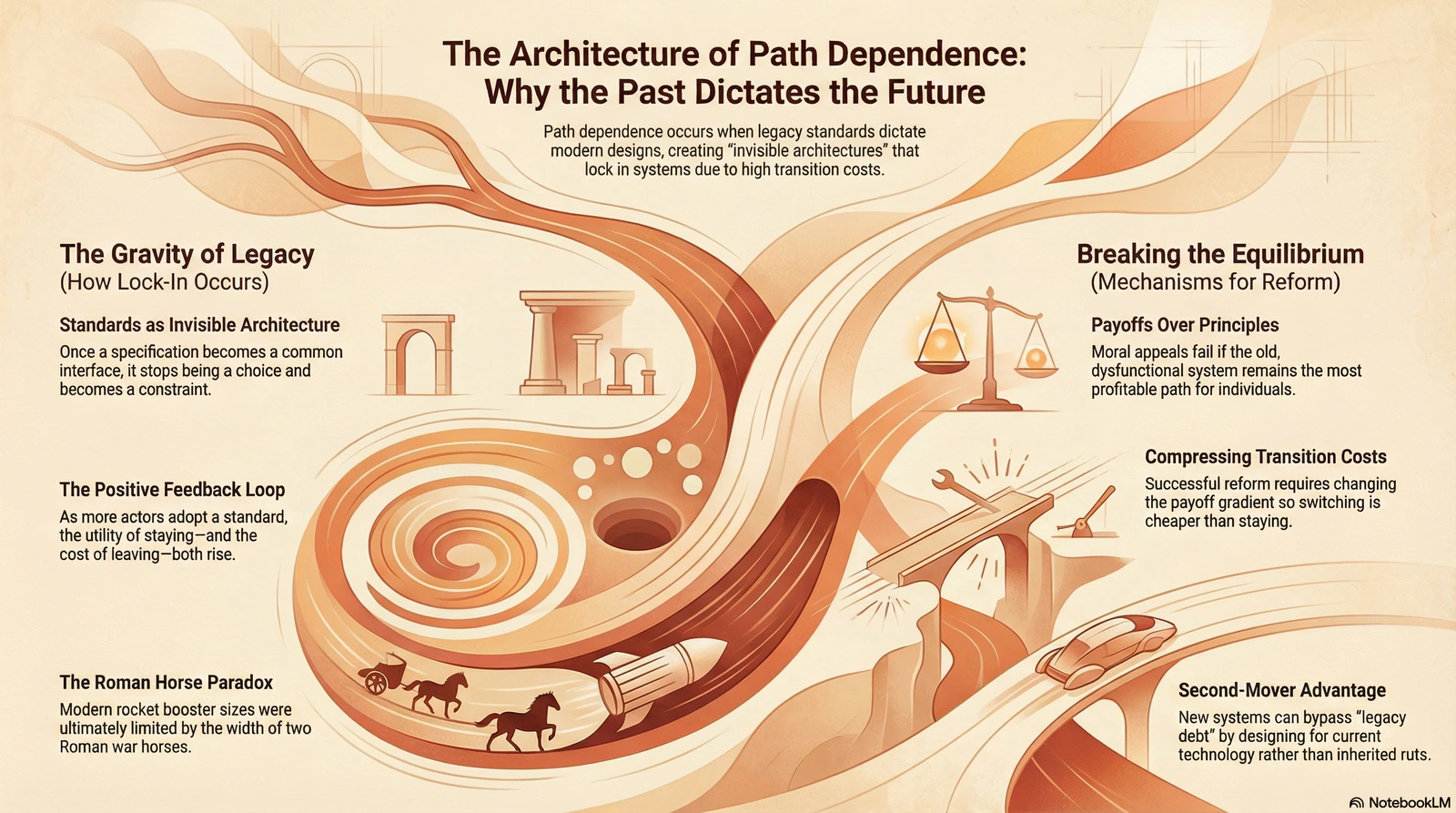
In the early 1970s, when rockets had already carried humans into orbit and the Space Shuttle was being designed, its solid rocket boosters still traveled on trains. That meant the booster design had to fit tunnel clearances the rail system already enforced. Those tunnels were engineered for railcars on the United States standard width, so the booster inherited a constraint it never selected. The lineage runs backward from Space Shuttle boosters to US railroads to English tramways and then to Roman Empire war chariots. The rail spacing is 8.5 inches, a strangely precise figure that is less of a choice and more of a constraint. It is not a round number. It is a historical residue. That width traces backward from American railroads to English horse-drawn tramways that existed before railroads even became an industry. The tramways inherited the spacing of cart wheels that could survive existing road tracks, and everyone else conformed to avoid destroying their cart wheels. Many of those road tracks were set by Roman roads and the wheel spacing of Roman war chariots. The chariots were made only as wide as the rear ends of two Roman war horses, and repetition turned that width into a standard, which is the Roman Horse’s Ass paradox.
The story matters because it shows how standards stop behaving like choices. Once a specification becomes a common interface, it stops being a preference and starts functioning like an invisible architecture that future systems must route through. The most advanced engineering then ends up negotiating inherited dimensions rather than selecting freely from a design space. The internet illustrates the same mechanism. IPv4, the internet routing protocol, was widely adopted because it worked, was simple and became the shared language through early adoption. When technology outgrew its assumptions, replacement became less about better engineering and more about an organized migration of everyone at once.
That same problem shows up in policy and markets, except the wheel tracks are legal and economic. Governments want firms to register, pay taxes and comply, yet informal activity persists even when governments campaign against it. The issue is not that people fail to grasp why formalization is desirable. The issue is that the environment has already settled into an equilibrium where staying informal is a rational best response. Formal firms face higher relative costs when competitors stay outside the system while still benefiting from public goods. Over time, the workaround becomes the normal workflow, and workflows become expectations that new entrants must satisfy. Reform then collides with grooves that were cut long before the reformers showed up.

Why Late Reform Faces Positive Feedback
Most institutional reforms fail for a reason that is not usually plainly stated. Reform shows up after the equilibrium has been selected, and the equilibrium has accumulated ways to protect itself. The old system is not merely dysfunctional; it is embedded in routines, expectations and private adaptations that make it stable. Beneficiaries emerge, but so do ordinary actors who depend on the workarounds to survive delay and uncertainty. Careers form around the old workflow, and informal side payments become a substitute for missing credibility. In that environment, reform is not a moral contest between good and bad actors. It is a contest between payoff structures, especially in environments with increasing returns.
A way to express increasing returns is to treat dysfunction as a coordination choice whose payoff rises with adoption:
Where is the utility to agent i from choosing option A when n other actors choose the same option, A is the entrenched behavior such as paying a bribe or remaining informal and n is the number of adopters in the relevant market, agency or sector. A positive slope means the behavior becomes safer and more profitable as participation expands. When informality is widespread, the lone formal firm pays taxes, faces enforcement friction and still encounters the same gatekeepers, so its cost becomes uncompetitive. When relationship-based contracting dominates, the honest supplier loses more than a bid and loses the capacity to plan. The math does not celebrate dysfunction. It diagnoses why slogans cannot overpower a positive slope. You do not move the equilibrium by volunteering one actor to take the loser’s payoff.
The First Mover’s Curse
First movers set standards, but they also get locked into a system of the earliest, most constrained version of the standard they chose. Early success attracts complements: specialized skills, supplier networks, compliance routines, political expectations and budget commitments. Over time, the system becomes more than a rule; it becomes an ecosystem of dependencies. This is why reform introduced late often looks coherent on paper and still underdelivers in practice. You are not contesting a single policy, you are contesting an installed base. Installed base economics is a mechanism: revenue, habit and complementary services accumulate around the incumbent equilibrium. Once the bundle is dense, marginal improvements do not translate into collective switching.
London’s underground metro system exemplifies the mechanism in metal and concrete. It was built early for small steam trains, so it dug narrow tunnels that later became the defining constraint of the entire network. Retrofitting modern, spacious air-conditioned trains is hard because the system lacks physical room to manage heat and airflow at the necessary scale. Contrast that with Hong Kong or Singapore, which built far later with the benefit of observing earlier mistakes and using later technology. They could dig wider tunnels, design for cooling and align stations with modern capacity assumptions. That is second mover advantage, designing for the current equilibrium without paying legacy debt. Late reform has the same problem: a digitized licensing or e-procurement platform introduced after decades of relationship-based discretion may reduce surface-level corruption points, but the equilibrium remains unless it changes who gains and who loses under the new workflow.

Conclusion: Transition Mechanisms That Make Reform Rational
Late reform is often packaged as moral urgency. Citizens must comply, public servants must stop corruption, firms must innovate and everyone is told to behave as if the environment has already changed. Those appeals fail because they do not alter the payoff gradient that made the entrenched behavior rational in the first place. If the utility of the entrenched behavior rises with adoption, then exiting it alone imposes an immediate loss. In repeated settings, regret teaches quickly, and regret usually teaches a return to the prior equilibrium. That is why late reform requires a transition mechanism rather than a virtue campaign. The task is to change best responses fast enough that the incumbent equilibrium cannot adapt in place.
Equilibrium-breaking moves work by compressing transition costs and sharpening payoff differences. Sometimes that means subsidizing the switch, so the first movers are not punished for moving early. Sometimes it means raising the cost of staying inside the old workflow through enforcement that is credible, automatic and hard to bargain with. Sometimes it means redesigning verification so compliance becomes cheaper than evasion, which is an institutional intervention rather than a lecture. In law and regulation, the core question is whether the reform removes discretion points or merely announces intent. In business, the parallel is whether the platform redesign changes defaults and interoperability, or simply publishes new guidelines. In international affairs, credibility works the same way: commitments bind behavior only when deviation is predictably punished by a mechanism, not by outrage.
Now back to the Space Shuttle image, because it captures the cost of arriving late. The engineers could not widen the tunnels, so the booster rockets had to be built in segments small enough to travel through inherited infrastructure. The compromise did not come from a lack of intelligence; it came from the architecture already being there. Systems that fail to break lock-in early end up tailoring the spaceship to fit a chariot world. A standard you keep too long eventually defines the boundary of what counts as possible. Do not allow a dead empire to set the boundary conditions of your strategy.