Introduction: The 18-Day Mirage
At the start of January 2011, the global intelligence community still viewed Hosni Mubarak’s Egypt as a stable regime. The visible indicators supported the judgment. Growth data looked acceptable, the armed forces were resourced and the security apparatus retained command over the physical machinery of the state. For an analyst trained to read static strength, Egypt resembled a durable authoritarian system with ample coercive capacity and few immediate threats. Then the protests of January 25 arrived. On February 11, Mubarak resigned after nearly three decades in power. The collapse happened so quickly that it invited a familiar interpretation: the regime was stable until one extraordinary shock broke it. That explanation is orderly, satisfying and usually wrong.
Regimes endure because citizens expect others to remain passive, because security institutions expect coordination from one another and because small disturbances are still absorbed before they spread. Firms retain customers for a similar reason. Users tolerate disappointments, switching remains costly and users still believe tomorrow will be tolerable. In both settings, loyalty is less an emotion and more like an equilibrium. It is a behavioral equilibrium sustained by shared expectations about what others will do. Once those expectations weaken far enough, exit begins to look rational, visible and contagious. That is why the period that appears calm can be the most deceptive phase. Fragile systems usually decay quietly, then unwind quickly. Seen this way, the deepest asymmetry is not just collapse. It is hysteresis: once a system has crossed into a new state, restoring the old conditions does not automatically recreate the old confidence.
Measuring Resilience Under Strain
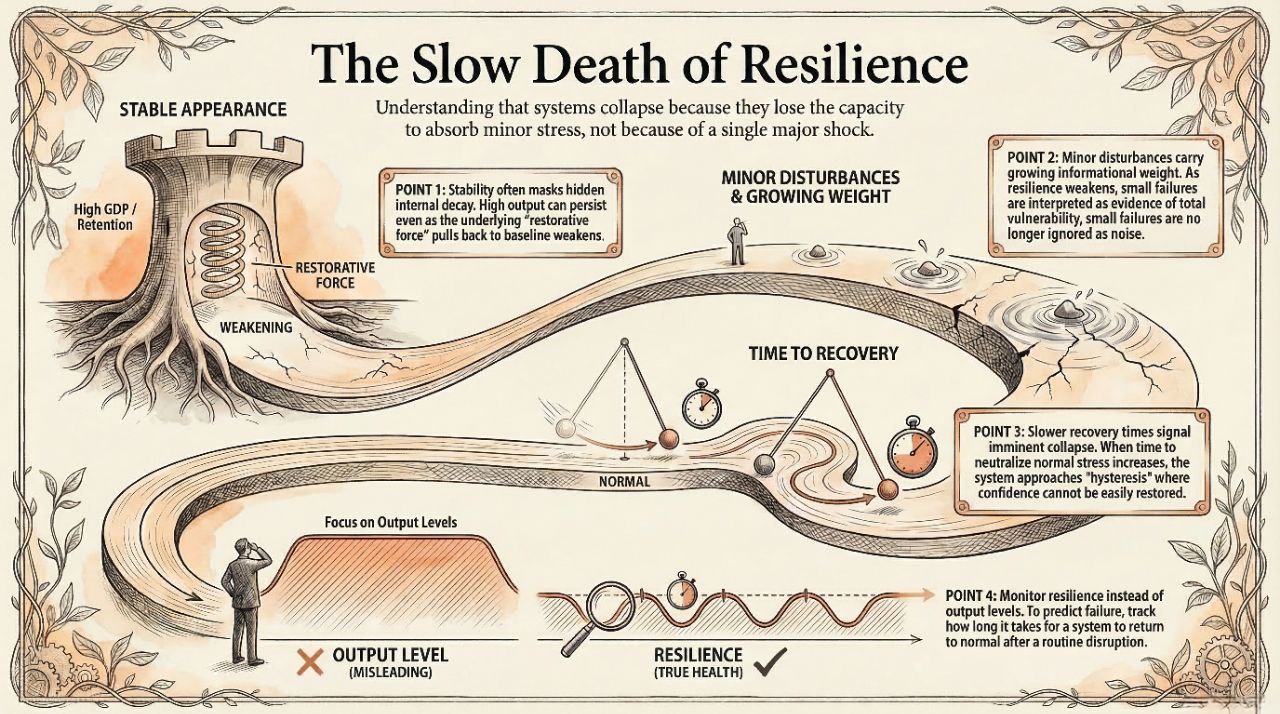
What looks like stability can often be a system losing resilience in plain sight. When a system is deeply trusted, ordinary failures are absorbed because those failures are still discounted as noise. A policy error, a delayed response or a service lapse is treated as unfortunate but temporary. As trust erodes, the same small disturbance begins to travel further through public belief. The system becomes slower to recover and each small disturbance carries more informational weight than it once did. What looked like a local protest starts to look like evidence of vulnerability. A routine outage starts to look like evidence about priorities and neglect. The central variable is not the size of the latest shock itself. It is the shrinking capacity of the system to absorb that shock without changing how people read the future. That mechanism can be expressed with a single governing rule:
Where x represents the system’s response to ordinary disturbances, σϵ represents the background volatility of those disturbances and α represents the system’s restorative force, meaning the degree to which trust and coordination pull conditions back toward baseline. As α moves toward 1, the denominator shrinks and the variance of the response rises sharply. In practical terms, recovery takes longer, the aftereffects of disturbances persist and small failures begin producing larger swings in sentiment and belief. That is the hidden structure of fragility. The system is not failing because the world suddenly became more dramatic. It is failing because the system has grown too sluggish to neutralize normal stress without transmitting it as a broader signal of weakness.
The Spread of Departure
This is what made Mubarak’s fall so easy to misread. Intelligence agencies focused on the visible power of the state when they should have focused on the persistence of small disruptions. In the 1990s, a minor labor strike in Cairo could be suppressed and forgotten within hours. By 2010, smaller labor actions, including unrest in textile sectors, were taking longer to resolve and leaving more visible residue. That change mattered more than the headline level of protest. It revealed the regime’s weakening capacity to restore baseline after ordinary stress. The system still looked strong in level terms, yet its recovery profile was deteriorating. Stripped of the politics, the signal was simple: the state was taking longer to absorb small shocks, which meant the beliefs sustaining obedience were already becoming unstable.
Firms often make an almost identical mistake when they interpret customer loyalty. They read turnover as a linear key performance indicator and then infer brand durability from a high retention rate. Complaints increase, delivery quality slips and service declines modestly, yet the customer base remains intact. Management teams then conclude that the brand remains strong. But repeated failures do not just generate isolated dissatisfaction. They slowly alter how customers interpret the relationship with the firm. Early on, users excuse a glitch because they still expect competent recovery. Later, the same glitch is interpreted as evidence about reliability, competence and respect for the relationship. Silence then becomes especially dangerous. Customers stop escalating not because trust is deep, but because they are recalculating whether the relationship still deserves effort.
Once that threshold is crossed, exit becomes contagious. In politics, citizens who once believed protest was futile begin to update on the visible participation of others. In business, customers who once tolerated friction infer whether leaving has become easier, safer and more justified. A single pricing change or a small outage can then trigger an exodus that feels abrupt only to people who were tracking levels instead of resilience. The same mechanism links political legitimacy and customer churn. In both cases, what matters is not the final trigger in isolation. It is the prior erosion of belief that turned the final trigger into a credible signal as permission to exit.

Conclusion: Listening to the Echoes
The implication is straightforward. You cannot infer systemic health from output alone. High GDP does not prove political stability, just as high retention does not prove durable loyalty to a brand. The more useful question is whether the system still dampens ordinary disturbances or whether it merely postpones the visible break. For states, that means tracking whether food price spikes, local protests or online mobilizations dissipate quickly or leave increasingly persistent aftereffects. For firms, it means asking whether service failures are becoming more clustered, whether complaint patterns repeat more often and whether trust restoration now requires more time and effort after each incident. Decision makers usually monitor level because level is easy to monitor. What needs to be monitored is resilience, because resilience determines whether shocks die out or accumulate.
So the deeper mistake is analytical before it becomes operational. We devote too much attention to the final spark and too little to the slow erosion of recovery capacity. We describe collapse as an event when it is more often a threshold process developing inside ordinary fluctuations. A better design response is to build sensors that track persistence, recovery time and clustering, then tie response thresholds to those signals before visible collapse arrives. In law and public governance, burdens and standards matter because they impose friction before coercive overreaction becomes too easy to justify. In firms, complaint-handling systems and escalation rules matter because they preserve legitimacy before distrust compounds. The danger is assuming the edge will announce itself. When a system begins to echo what it once absorbed, the break is already near.