Introduction: The Silence before the Crash
A hedge fund called Long-Term Capital Management (LTCM) would define modern financial history. Dubbed the “perfect” fund, it was conceived by the “dream team” of finance led by two Nobel Prize winners, Myron Scholes and Robert Merton. It was a coalition of theorists who believed they had tamed uncertainty. Their ambition was simple. They wanted to strip risk out of the market to create a system that basically printed money.
For four years it worked perfectly. Their returns were high with remarkably low volatility. By the standard metrics of the day, it was the safest investment in global finance. Then the Russian government defaulted on its debt. LTCM lost $4.6 billion in weeks and the Federal Reserve Bank of New York convened Wall Street’s leaders for an emergency rescue. The volatility they had suppressed for years returned all at once in a catastrophe that threatened to collapse the global banking system.
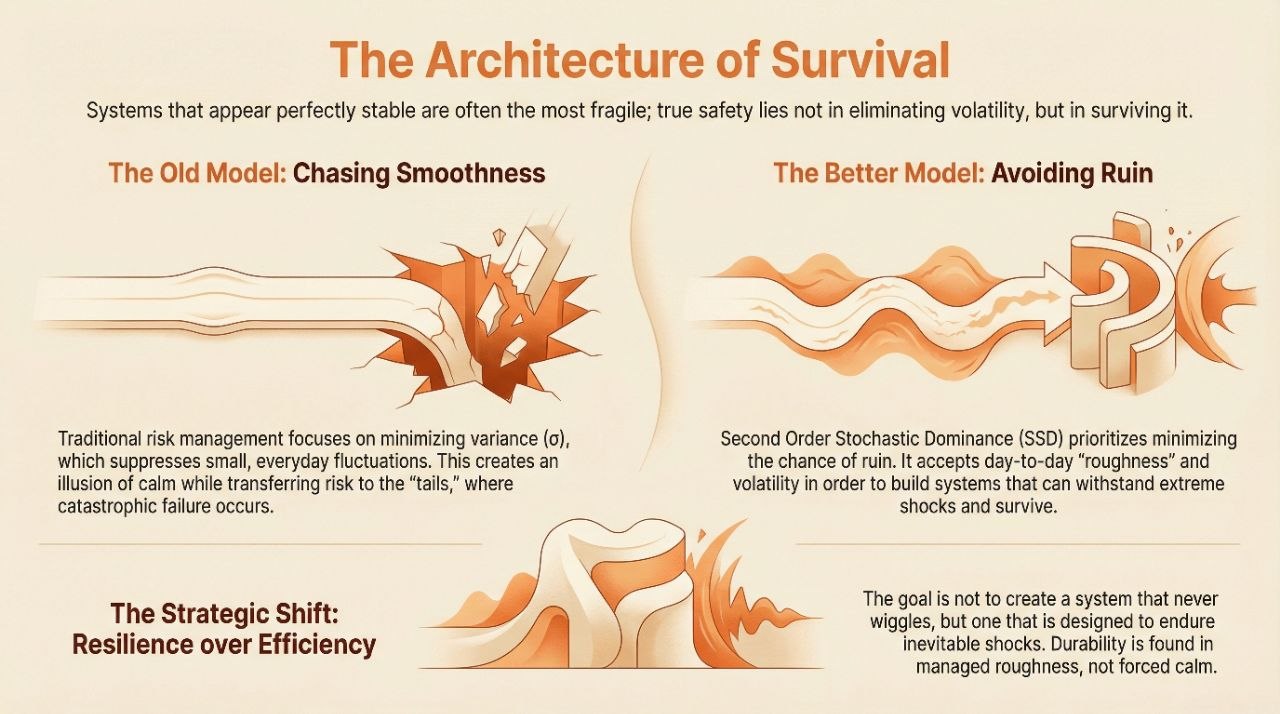
The collapse revealed a deeper insight about complex systems. In complex systems you cannot destroy risk. You can only move it. LTCM did not eliminate volatility. It rather transferred the energy of small fluctuations into the tail of the distribution where ruin lives. This is the logic of risk conservation.

The Mathematical Blind Spot
To understand why decision makers keep making this mistake, recognize that this mistake begins with a familiar tool. Most decision makers define risk as variance represented by:
Variance measures dispersion around the mean. A simple metaphor is to picture variance as a motion sensor that beeps whenever something moves. It does not matter whether the movement is a jump forward or a fall. It only measures distance from the center.
This logic is encoded in the formula:
The square treats a positive surprise with the same penalty as a negative shock. The movement is the problem. Direction does not matter. This creates a subtle incentive. Decision makers who want to look competent smooth the data to keep σ low. A lower variance score signals control even when the system is becoming fragile. Variance rewards the illusion of calmness, not resilience. If variance blinds us to tail exposure, we need a model that favors survival instead of smoothness. The bridge to that model is human behavior.
The Psychology of the Paycheck
Humans naturally avoid uncertainty. Presented with a steady salary of $5,000 or fluctuating income that averages $6,000 but occasionally hits zero, most people choose the steady path. If humans optimized only for expected value, we would select the higher average. Yet we do not. We would rather protect against the worst case.
The mathematical form follows:
Option A dominates option B at the second order (SSD) when the averages are the same and option A is less ‘scary’ (less volatile/risky). SSD values the shape of the downside, not the smoothness of the middle. Humans would rather trade mean return for a smaller chance of ruin.
This is why many public decisions that appear timid are actually disciplined. During the 2022 European energy crisis, policy makers faced a choice between rapid fossil expansion with geopolitical exposure or slower diversification with lower tail risk. Expected value favored expansion. But the leaders chose diversification. They were reducing the shaded area in the danger zone. SSD helps explain why modest policies outperform glamorous ones when survival is the objective.

Conclusion: Designing for Roughness
The lesson for strategists is counterintuitive. To endure volatility, we must stop trying to erase it. Systems that tolerate shocks survive and systems that suppress them fail.
An inefficient supply chain with multiple redundant vendors costs more in the short term but dominates in the long run because it cuts off the risk of total ruin. A “noisy” democracy is often more stable than a “quiet” dictatorship because the constant small conflicts release pressure that would otherwise build up to a revolution. That protects the system from crossing the ruin line.
True safety is not the absence of volatility. It is rather the absence of fragility. It lies in maximizing the space for survival over time. In an era defined by shocks and interdependence, the durable strategy is the one that accepts shocks and designs for roughness rather than fear it.