Introduction: The Paralyzed Empire
In the late 16th century, the Spanish Empire covered oceans and continents, yet its decisions moved at the speed of paperwork. From the Americas to the Philippines, messages from colonies, fleets and governors all funneled toward Madrid, where King Philip II ruled as the “Paper King.” He distrusted delegation and treated authority as something that lost fidelity the moment it left his hands.
Philip worked as if effort could substitute for design. He kept long nights, reading and annotating endless bundles for hours each day, pushing his personal workload toward maximum. But an empire is not a steady stream of identical tasks. Storms scatter fleets, rebellions appear without schedule, couriers arrive late and what is true today becomes irrelevant by the time it is approved. In that environment, running the center at maximum load is not discipline. It is a decision to let volatility dictate outcomes. Philip’s centralization did not merely slow the empire. It made delay compound.
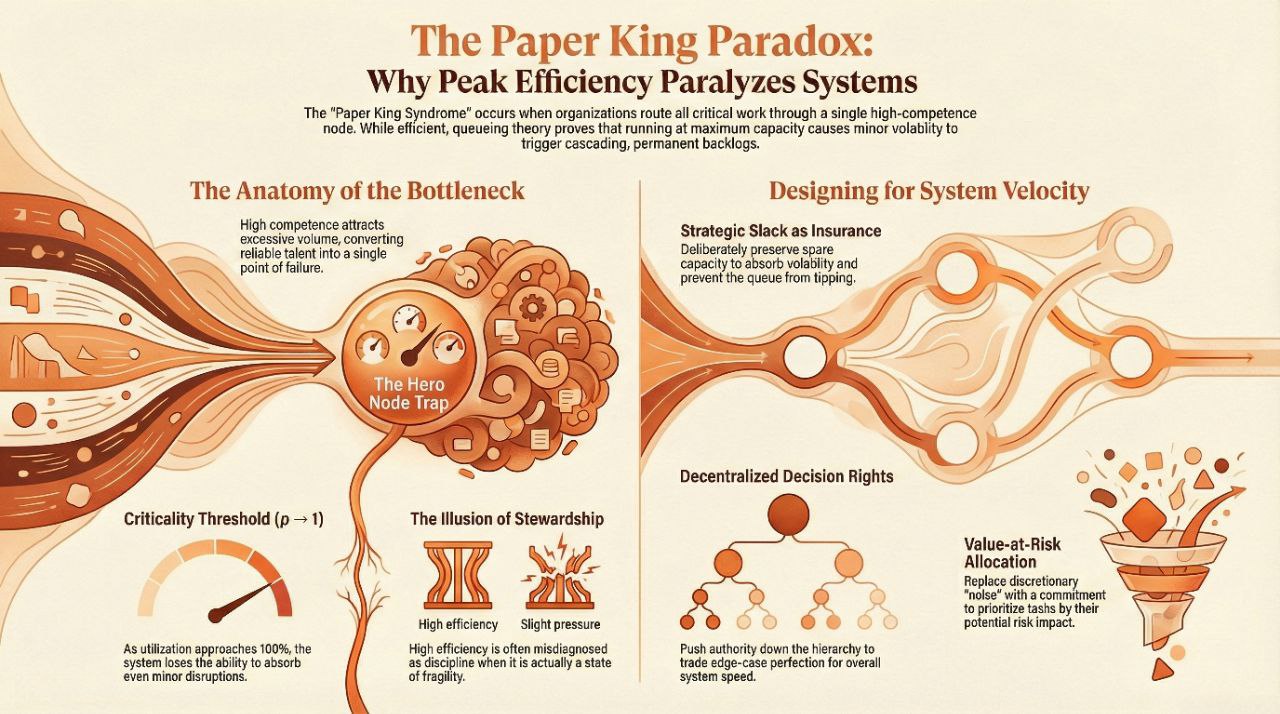
Philip’s micromanagement is not mainly a character story. It is a system story. Every institution is fundamentally a network of queues. Work arrives, waits, gets processed, then moves to the next stage. The point is not that Philip was stubborn. The point is that he built a system where the most consequential decisions had to pass through one node, so the system inherited that node’s fragility. Spain did not lack ships or money so the empire did not suffocate from scarcity. It suffocated inside the king’s inbox.

The Modern Paper King and the Hero Penalty
You can find the same pattern inside modern organizations, dressed up as performance. Every firm has a version of the 10x employee: the architect who can stabilize a system during an incident, the partner whose judgment closes the hardest matters, the executive who can negotiate the critical tradeoff without a meeting. Leaders then do what seems rational. They route high-stakes work toward that person because it feels like the highest-quality allocation to the best person.
This is where competence becomes a trap. Competence attracts volume. If you keep solving the hardest problems, more hard problems get routed to you. The reward for making clean decisions is that the organization assigns you more decision rights. The result is a “hero” node that attracts volume faster while processing capacity remains fixed. Even when the hero stays calm and productive, the system shifts risk onto that one desk. The organization then praises “reliability” while it quietly converts the reliable person into a bottleneck.
The same posture shows up in supply chains under a friendlier name: just-in-time supply chains. Just-in-time is an optimization that removes buffers to maximize efficiency. It assumes disruptions are rare, lead times are stable and recovery is fast enough to make slack look like waste. That assumption is never stated as a doctrine, but it lives inside the design. That posture works until it does not. When volatility rises, the system discovers that the buffer is not a waste. It is a mechanism to keep flow from turning into backlog.
The Physics of Neglect
Most leaders have a linear intuition about queues. A little more workload should create a little more waiting. If the team is busier this week, the queue should be slightly longer, then it should clear. That intuition is reasonable in a world of steady inputs and predictable tasks. However, it collapses under uncertainty, because queues do not scale smoothly near capacity. They flip.
Queueing theory defines the flip with a single identity:
Where λ is the rate at which work arrives, μ is how quickly it can be processed and ρ is utilization, the share of capacity already committed before the next disruption. In decision terms, ρ is the risk posture of the node. When ρ is low, variance is absorbed. When ρ approaches 1, variance becomes dominant. A late courier, a slipped meeting or a missing shipment stops being a minor disturbance and becomes a generator of accumulated delay.
This was the Paper King’s true mistake. He treated high efficiency as evidence of good stewardship. Yet at the boundary, high efficiency is not stewardship. In reality it places the system in criticality, where small disruptions trigger cascading backlog. The closer a critical node runs to full, the more the system hands leverage to randomness. Under high efficiency, waiting becomes the dominant product.

Conclusion: Designing the Queue
Once the mechanism is accepted, the intervention is not “work harder.” It is redesign. Operational thinking focuses on clearing backlogs after they appear. Strategic thinking treats the backlog as a predictable output. The first intervention is to treat spare capacity as insurance rather than waste.
In practice that means capping utilization where decisions concentrate. Top talent, key committees, high-impact systems should not be run at the edge. Deliberately preserving room for volatility prevents the queue from tipping into a permanent backlog. The second intervention is to decentralize and push decisions down the hierarchy. You accept that some decisions will be imperfect at the edge in exchange for system velocity. If delay is inevitable, the next question is allocation. Under backlog, attention becomes a scarce resource, and discretion becomes a mechanism that rewards noise. Replace discretion with commitment, because discretion under backlog becomes a contest for attention. Allocate by value at risk rather than by volume. Queues distribute power as surely as they distribute time.
The closing rule is simple. Delay is a cost, and whoever designs the queue is designing distribution.